Article
Govern AI agents by autonomy level, not by vendor or model
When a team talks about agents, the conversation usually drifts to the model or the vendor. That only matters at the surface. The same model can stay inside a read-only box, or it can be allowed to touch data, open tickets, send messages, change states or start workflows. The real question is not which engine sits underneath. It is how much autonomy you are giving it.
On May 26, 2026, Gartner said that applying uniform governance across agents, without separating action capability from access scope, is a path to failure. That distinction matters for small teams too. An agent should not be governed by the model name alone, but by what it can see, what it can change and how expensive a mistake would be.
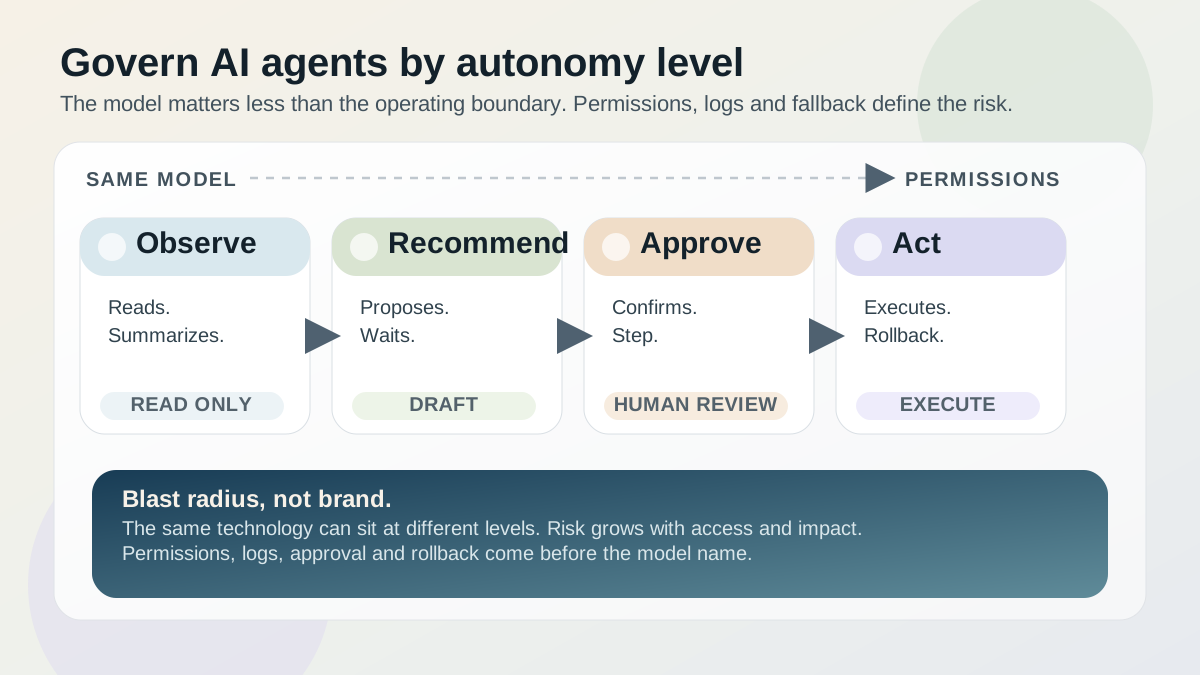
The model is not the boundary
The model is only one part of the system. The real boundary is the permission surface: what it can read, what it can write, what it can send, what it can delete and what it can trigger. An agent that reads internal documents is not the same as an agent that can modify records, send customer emails or launch a payment workflow.
This is where another concept matters more than the vendor name: blast radius. If the agent is wrong, how far does the damage spread? A bad summary is annoying. A bad permission change, a wrong amount or a broken operational state can become expensive very fast.
Useful governance starts there. Not from “this model is better”, but from “this agent can only read”, or “it can suggest an action”, or “it can execute only after approval”, or “it can act alone inside a narrow, reversible scope”.
This is the same operating logic behind agent queues and model routing for AI coding: autonomy should be assigned to a task class, not to the excitement around a model.
Four autonomy levels
I would keep the framework simple. Four levels are enough to make most decisions.
| Level | What it does | Control required |
|---|---|---|
| Observe | reads, classifies, summarizes | minimal review |
| Recommend | suggests actions or decisions | human approval |
| Act with approval | prepares an action and asks for confirmation | approval at each step |
| Act alone | executes reversible tasks inside a narrow scope | logging, limits, fallback |
The important part is that the level does not depend only on the model. It depends on the operating context. The same agent can sit at level 1 in a finance workflow and level 4 in an internal reporting flow if the permissions are different and the maximum damage stays contained.
That is why “agents yes” or “agents no” is not a useful decision. The real one is much more concrete: should this agent read, recommend or act?
The right questions before switching it on
Before giving an agent autonomy, I would ask four questions.
- What can it see?
- What can it change?
- What happens if it gets it wrong?
- Who stops it, and how?
If any of those answers are fuzzy, the agent should stay in observe or recommend. Not because AI is inherently dangerous, but because the team has not defined its boundary yet.
The difference between a mature team and an improvised one is simple. The mature team writes the rules before increasing autonomy. The improvised team writes them after the first incident.
Same model, different risks
This is the part that gets lost in vendor talk. The model does not determine risk on its own. Access, context, integrations and reversibility do. An assistant that rewrites an email draft does not carry the same weight as an agent that can touch a CRM, a billing system or an approval workflow.
That is why the useful question is not “which model should we use?”. It is “which autonomy level are we willing to grant, on which system, for which task, with which fallback?”. Once the team can answer that, model selection becomes important, but it is no longer the center of the decision.
The good thing about this approach is that it works for small founders and larger organizations alike. It does not require a committee. It requires clarity on permissions, consequences and ownership.
What to do in practice
If a team wants to introduce agents without creating chaos, I would start with three moves.
- Map tasks by autonomy level, not by model.
- Define the permission surface and the maximum acceptable blast radius for each task.
- Keep human review in place until the agent has proven it can fail in a legible and reversible way.
That is the least glamorous part of the work, but it is what keeps the system standing. Agents become useful when we stop treating them like demos and start treating them like parts of a process.
If you cannot explain an agent’s autonomy level in one sentence, you do not have governance yet. You just have a more elegant name for automation.