Article
Category strategy needs behavior maps
A new category is not created when a team finds a clever label. It is created when customers start acting differently and have a reason to repeat that action. That is why category strategy needs behavior maps, not feature positioning.
Feature positioning is still useful once the buyer knows the game. It helps compare one CRM with another CRM, one analytics tool with another analytics tool, one help desk with another help desk. But a category-shaping product often arrives before the buyer has a stable buying checklist. The prospect may feel the pain, but describe it as a workaround, a coordination tax, a messy spreadsheet, or a habit everyone tolerates. If the product team starts with features, it forces the customer to translate. Most customers will not do that work.
Stewart Butterfield’s famous Slack memo is valuable because it frames the work as translating value into customer terms and selling a change in how organizations operate, not merely selling software functionality. In his words, Slack was not just selling a tool category that buyers already understood. It had to help customers see the organizational transformation they were actually buying. That is the strategic move: define the new behavior before you decorate the message. Butterfield’s memo remains a useful primary source for this discipline.
The feature is not the category
A feature says what the product can do. A category says what kind of work now deserves a different routine. The difference matters because early customers do not only ask, “does it have the feature?” They ask, often silently, “where does this fit in my day?”
Imagine a product that turns scattered customer notes into shared product evidence. The feature list might mention tagging, search, summaries, permissions, integrations, and exports. Those claims are not wrong. But they do not yet explain the category. The category claim is closer to a behavioral sentence: product decisions should start from a visible evidence trail, not from whoever remembers the loudest customer call.
That sentence changes the buyer’s operating model. It implies that interviews are logged, claims are linked to examples, roadmap debates refer to evidence, and leadership can inspect the basis of a bet. If the product page only lists capture and search features, it misses the behavior. If onboarding only asks users to connect tools, it misses the first proof. If the sales deck only compares functions, it misses the reason the category should exist.
This is also why category work belongs near strategy, not only near copywriting. The argument in Product strategy needs choice maps, not priority stacks applies here too: a strategy is not a pile of attractive options. It is a visible set of choices about what behavior you will privilege and what behavior you will stop rewarding.
What behavior is your category asking for?
A behavior map is a small operating artifact. It should fit on one page. Its purpose is not to produce a slogan. Its purpose is to prevent the team from hiding behind a slogan.
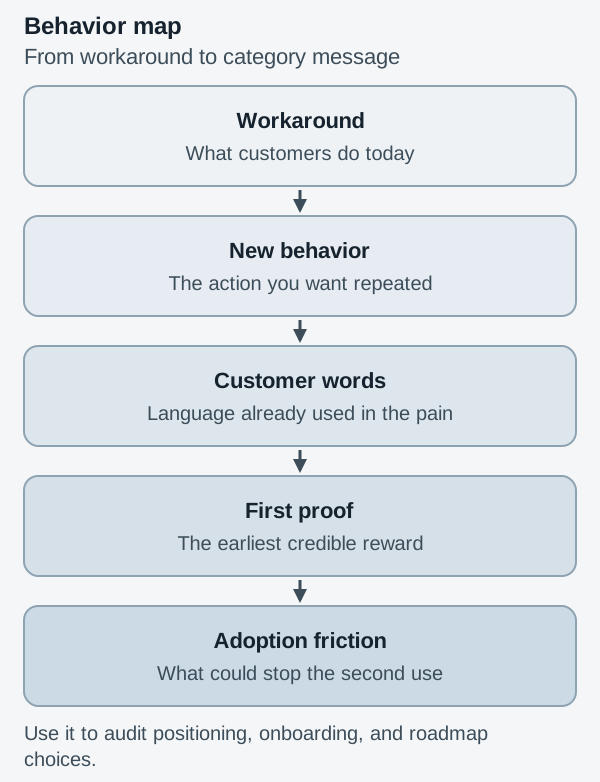
Start with the current workaround. Write what the customer does today in plain language. Not “legacy collaboration process,” but “the team searches three channels, asks two people, and rebuilds context before every decision.” The workaround should sound like a scene someone recognizes.
Then write the desired new behavior. This must be observable. “Be more aligned” is not a behavior. “Before a roadmap review, every proposal links to three customer examples and one counterexample” is a behavior. If you cannot observe it, onboarding cannot prove it and customer success cannot coach it.
Next, capture customer language. Category creators often overvalue their own nouns. Customers may not say “knowledge orchestration,” “revenue intelligence,” or “decision infrastructure.” They may say “where did we decide that?”, “who has the latest version?”, or “why are we doing this again?” The map should preserve those phrases because they carry the emotional truth of the problem.
Then define onboarding proof. What is the first moment when the customer sees the new behavior work? Not the full ROI case. Not the annual transformation story. The first proof. For Slack, the early proof was not a feature tour. It was the feeling that team communication had moved into a searchable, shared, lower-friction place. For your product, it might be the first decision made without a status meeting, the first support issue solved without asking engineering, or the first forecast reviewed with the underlying assumptions visible.
Finally, name adoption friction. The friction is not a footnote. It is part of the category. If the new behavior threatens someone’s authority, adds data-entry work, exposes weak decisions, or requires a team ritual to change, positioning must address it. Otherwise the product may win interest and lose usage.
Map the behavior before the message
Once the behavior map exists, the product page becomes easier to judge. Every section should answer one of five questions: what workaround are we replacing, what behavior should happen instead, what words does the customer already use for the pain, what proof will they experience first, and what friction have we made safe?
The hero line should not merely name the product class. It should point to the improved behavior. The problem section should show the workaround without insulting the customer. The feature section should connect capabilities to the new routine. The proof section should show the first credible change, not a distant promise. The implementation section should reduce the first adoption fear.
This changes roadmap conversations too. A requested feature is not only evaluated by revenue potential or implementation size. It is evaluated by whether it strengthens the desired behavior. Does it make the new routine easier to start? Does it make the reward more visible? Does it reduce the friction that blocks the second use? If not, it may be a useful feature but a weak category investment.
The same discipline protects planning. As argued in Planning needs public evidence, not confident forecasts, teams need visible evidence to make better bets. A behavior map is public evidence for positioning. It shows what the company believes customers are ready to stop doing, start doing, and repeat.
Where onboarding proves positioning
The most honest test of category strategy is onboarding. A landing page can claim transformation with beautiful language. Onboarding has to make someone take the first step.
If the desired behavior is “run every customer escalation from a shared timeline,” onboarding cannot begin with ten configuration screens. It should help the user create or import one escalation, invite the minimum useful collaborators, and experience the value of the shared timeline before asking for full setup. If the desired behavior is “review marketing spend by decision boundary instead of channel vanity metrics,” onboarding should not start with every possible integration. It should help the user label one decision, connect enough data to inspect it, and see how the new review changes a budget conversation.
This is where many category attempts fail. The marketing says, “work in a new way.” The product says, “complete these settings.” The customer says, “I will come back later.” The behavior map catches that mismatch early. It forces the team to ask whether the first session proves the category or merely administers the account.
Onboarding proof also creates better sales material. Instead of abstract benefit claims, the team can say: here is the old workaround, here is the first new action, here is what you will see in the first week, and here is the friction we remove. That is more concrete than benefits-not-features advice because it names the customer’s change in motion.
Audit one category claim
Take one product page, sales deck, or onboarding path and write a five-line behavior map beside it.
Current workaround: what does the customer do today when your product is absent?
Desired behavior: what should they do differently after adopting it?
Customer language: what phrases do they already use when the pain appears?
Onboarding proof: what first moment shows the new behavior is better?
Adoption friction: what irritation, fear, politics, or effort could stop repetition?
Then mark every section of the page or flow with one of those five labels. If a section has no label, it may be decoration. If the desired behavior appears only in the headline, the strategy is too thin. If friction appears nowhere, the story is avoiding the real sale. If proof comes too late, onboarding is not carrying the category.
The thesis is simple: category strategy needs behavior maps, not feature positioning. The map will not replace taste, narrative, or product judgment. It will make them accountable to the behavior the customer must actually adopt. That is where a category stops being a naming exercise and becomes an operating choice.