Article
Fable 5 is back: benchmarks, stops and safeguards
When a new model comes out, most of us look at the benchmarks first. That makes sense: we need a quick way to understand whether the model is worth testing, whether it costs less, writes better code, reasons for longer, or handles tasks that used to break after a few steps.
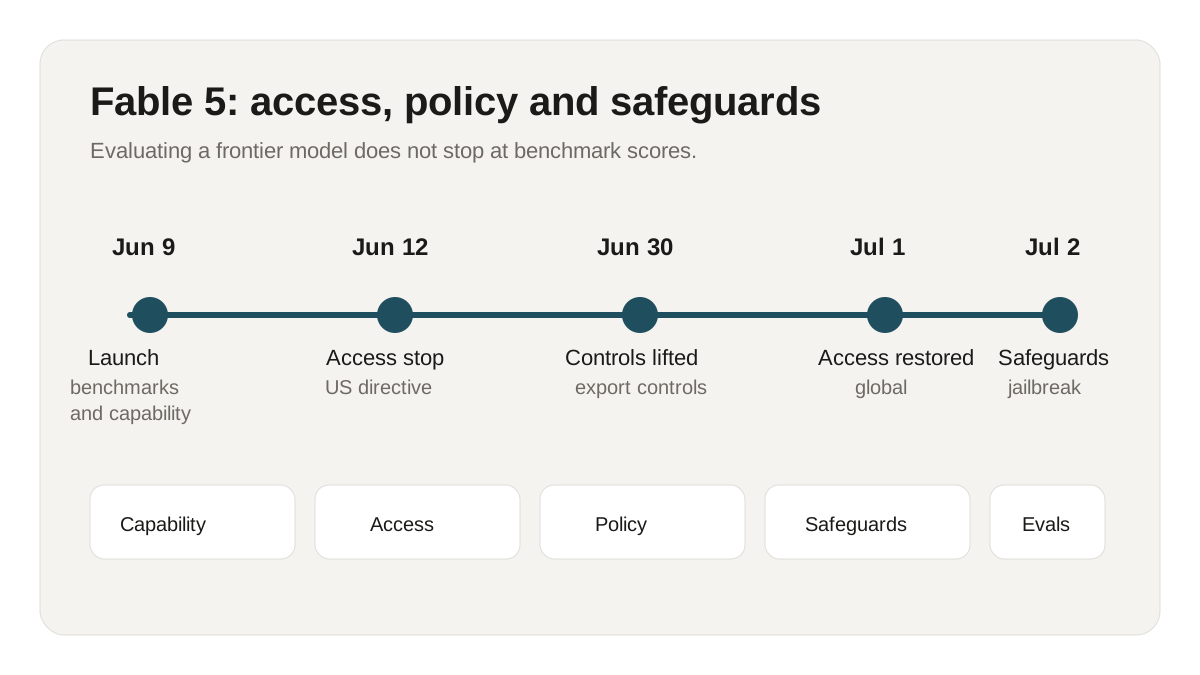
Claude Fable 5 is interesting because it makes that reading too small. On June 9, 2026, Anthropic announced Fable 5 and Mythos 5, describing Fable as a Mythos-class model made available for general use with safeguards active. Three days later, on June 12, the company said it was suspending access to Fable 5 and Mythos 5 after a US government directive. On June 30, Anthropic announced that the export controls had been lifted, and on July 1 access was restored.
If we read this only as a benchmark story that got interrupted, we miss the point. Fable 5 did not only raise the question of which model is strongest. It made a more practical question visible for teams building with AI: what happens when model capability, policy, safeguards, benchmarks and commercial availability become part of the same operating system?
The benchmark is not the product
In its launch post, Anthropic described gains in software engineering, knowledge work, vision, memory and scientific research. It also shared examples and benchmark references where Fable 5 looked strong, especially on long tasks and agentic coding. Those signals are useful, but a team does not buy a benchmark. It buys the likelihood that a model will improve a real workflow.
That distinction matters. A model can rank highly and still be the wrong choice for a team if it creates too much friction in daily use, triggers too many fallbacks, has unpredictable costs, or blocks parts of the operational work through policy.
For a founder or CTO, a benchmark should start the evaluation, not finish it. The real work is deciding which tasks you want to improve: code modernization, prototyping, document analysis, internal workflows, automation. Then you have to test whether the improvement survives inside your context, with your data, your constraints and your review process.
Safeguards are part of the experience
Anthropic explained that Fable 5 uses separate classifiers to detect potentially risky requests, especially around cybersecurity, biology, chemistry and distillation. In some cases, instead of letting Fable answer, the request is handled by Claude Opus 4.8. In the launch post, Anthropic said that more than 95% of Fable sessions would involve no fallback, and on July 2 it published more detail on its jailbreak and safeguard framework.
That sounds like an implementation detail, but for builders it is product. A safeguard is not only a safety policy: it changes the user experience, workflow predictability and team trust. If I am using a model for a coding assistant or AI-assisted delivery, I need to know when I am talking to the primary model, when there is a fallback and how that affects quality, latency and behavior.
This is not an argument against safeguards. On more capable models they are unavoidable, and often necessary. The point is that they become part of the architecture of the product you build on top of the model. You cannot treat them as something outside the system.
The government stop changes how access should be read
The June 12 suspension made another thing visible: access to a frontier model can depend on factors you do not control. Anthropic wrote that, because it had no reliable way to verify nationality in real time, it suspended access for all users. On June 30, it said the export controls had been lifted and that Fable 5 would return globally on July 1 across Claude Platform, Claude.ai, Claude Code and Claude Cowork.
For teams building internal AI systems, this does not mean avoiding frontier models. That would be too defensive. It means designing with clearer assumptions: which parts of the workflow depend on one specific model, which parts can degrade to another model, and which data or operations must not stop if access changes.
It is the same principle that applies to any critical dependency, except this dependency evolves faster and mixes product, security and regulation.
Benchmarks, evals and real work
The Fable 5 case makes one distinction clearer: public benchmarks, internal evals and human review do not measure the same thing. A benchmark tells you something about the general frontier. An internal eval tells you whether the model works on your cases. Human review decides whether the output can become product. This is the same principle behind AI-assisted delivery: the model generates, but the team decides what can enter the product.
When those levels get mixed together, teams make fragile decisions. They adopt the model that wins the leaderboard, then discover that it fails on ordinary company tasks. Or they discard a model because it is not first in public rankings, even though it would be more stable, cheaper or easier to govern in their specific workflow.
For a small team, the practical question is not “is Fable 5 the best model?”. A better question is: which tasks do I want to give it, how will I decide whether it did the work well, and what happens when the model cannot or should not answer?
What to keep
Fable 5 is a strong news story because it touches several layers at once: capability, benchmarks, safeguards, export controls, access and trust. But for people building products, the value is not in commenting on the ranking of the week. It is in understanding how the way we evaluate and govern models is changing.
If a team uses AI to write code, analyze documents, generate insight or automate processes, it can no longer choose a model by looking only at performance and price. It needs at least three more questions: which safeguards can enter the workflow, which internal evals are needed to measure real quality, and what fallback plan exists if model access or behavior changes.
Benchmarks will keep being useful. They are no longer enough to decide.