Article
AI product milestones need demo-to-product gates
The demo is not the milestone
An AI demo is a useful learning artifact, but it is a dangerous product milestone. A demo proves that a narrow path can work once, often with friendly inputs, a patient operator, and a room full of people who want the thing to succeed. A product has to work when the user is distracted, the input is messy, the latency is visible, the output is disputed, and nobody from the project team is standing beside the workflow.
That is why the milestone should not be demo complete. It should be gate passed. The thesis is simple: AI product milestones need demo-to-product gates, not launch optimism.
Launch optimism sounds reasonable because the demo gives the team evidence. The model answered. The agent called the tool. The generated draft looked good. The user nodded. The risk is that this evidence is usually evidence of possibility, not evidence of readiness. Chip Huyen describes several generative AI application pitfalls that map directly to this gap: using generative AI when a simpler method would do, confusing bad product with bad AI, starting too complex, over-indexing on early success, and skipping systematic human evaluation. Her warning that demo-ready is much easier than production-ready is the reason a gate must exist before the roadmap celebrates the milestone. Chip Huyen, Common pitfalls when building generative AI applications
A gate is not a bureaucracy layer. It is a short operating ritual that asks whether the demo can survive the conditions of the real workflow. If it cannot, the decision is not failure. The decision is to keep the artifact in learning mode instead of pretending it is already a product.
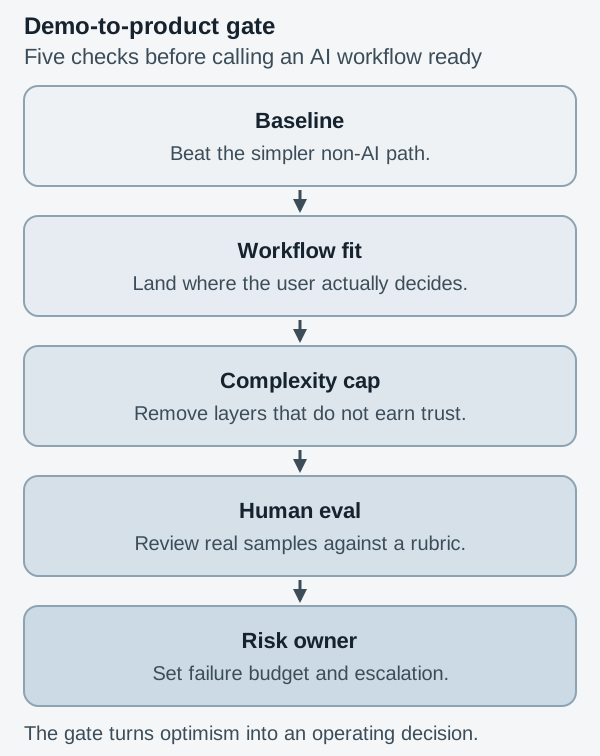
What belongs in a demo-to-product gate?
The gate should be small enough to use and hard enough to matter. Five checks are enough for most AI product builders and technical PMs.
First, define the non-AI baseline. If the workflow can be handled by search, rules, templates, a deterministic script, or a simpler machine learning approach, the AI version has to beat that baseline on a user-relevant dimension. Not novelty. Not internal excitement. A real dimension such as completion time, quality of decision, recovery from ambiguity, cost per successful task, or reduction in handoffs.
Second, test workflow fit. The question is not whether the model output is impressive. The question is where the output lands in the user day. Does it arrive before the decision is made? Does it require the user to rewrite everything? Does it create a new review queue that nobody owns? Does it ask the user to type into a blank box when the user would rather choose from suggested actions? This is where many teams mislabel a product problem as an AI problem.
Third, cap complexity. The gate should ask which parts of the demo are necessary and which parts are architectural theater. Remove the agentic framework if direct calls work. Delay fine-tuning if prompt and retrieval changes are enough. Avoid adding a vector database before the retrieval problem is understood. This connects to the operating discipline in Model selection needs task portfolios: choose the system around the task set, not around the most exciting component.
Fourth, require human evaluation. Automated evals are useful, but they should not be the only judge before launch. A small panel of domain reviewers should inspect real or realistic inputs, label failures, and write down what makes an answer acceptable. If humans cannot agree on the standard, the system cannot be considered ready just because an LLM judge returns a high score.
Fifth, assign a failure budget and an owner. The gate should name the tolerated failure modes, the escalation path, and the person accountable for each unresolved risk. A workflow that occasionally produces a weak draft is different from one that sends incorrect instructions to customers. A low-risk assistant can launch with visible review. A high-risk automation may need permission limits, queues, or rollback paths before any production claim is honest. This is adjacent to the argument in AI confidence theater: build workflows that hold, but the gate makes it a milestone decision rather than a cultural slogan.
Which question should stop the launch?
The most useful question is: what would make us embarrassed that we called this production-ready?
Ask it before the launch review, not after the incident review. The answer usually exposes the hidden gap. Maybe the demo only worked on clean internal examples. Maybe the user has no way to correct the answer without starting over. Maybe latency is acceptable in a conference room but painful in the workflow. Maybe the tool can take an action that should require approval. Maybe nobody knows how to tell whether a bad output came from the prompt, retrieval, model selection, product framing, or user input.
A good gate turns those anxieties into explicit checks. For example, if the risk is that the assistant gives plausible but incomplete answers, the gate requires a labeled set of incomplete-answer examples and a human review rubric. If the risk is that users will distrust the output, the gate requires a workflow test where users must decide whether to accept, edit, or reject the suggestion. If the risk is uncontrolled action, the gate requires permission boundaries and a queue, not another prompt line asking the model to be careful.
This matters because AI demos often hide the cost of the last mile. Early success can be real and still misleading. The first useful output proves that the direction has promise. It does not prove that the team understands edge cases, quality thresholds, support load, or user trust. A gate protects the team from converting excitement into premature commitment.
Where early success hides production risk
The most common hiding place is the handoff from model output to user decision. A summarizer can produce a good-looking summary while missing the one action item the user needed. A support assistant can answer correctly while sounding unhelpful. A coding agent can create a passing patch while ignoring acceptance criteria, which is why AI coding needs acceptance criteria first applies beyond software teams. The acceptance standard has to be defined before the AI artifact is treated as done.
Another hiding place is evaluation scope. Teams often test the happy path repeatedly because the happy path is available. Production requires the uncomfortable set: ambiguous requests, partial context, missing permissions, adversarial phrasing, stale data, duplicate records, and users who do not behave like the demo script. The gate should force the team to show what happens outside the demo lane.
A third hiding place is ownership. A demo can be carried by the builder. A product needs an operator. Who reviews the daily sample? Who changes the prompt? Who approves model upgrades? Who monitors cost? Who decides that the failure rate is now too high? If every answer is the team, the real answer is nobody.
Audit one AI workflow before launch
Take one demo that is being discussed as production-ready and run the gate in writing. Name the baseline. Describe the workflow moment. Remove one unnecessary layer of complexity. Have humans review a sample of outputs. Define the failure budget. Assign owners to the risks that remain.
The result may still be a launch. It may be a narrower beta. It may be a decision to ship a rule-based feature first and keep the AI version in discovery. All three are better than turning a good demo into a fragile product promise.
The point of a demo-to-product gate is not to slow AI work down. It is to make progress legible. Teams should absolutely build demos, because demos reveal possibility. But the milestone that deserves confidence is not the moment when the demo works. It is the moment when the workflow has survived the gate.