Article
Production agents need runtime guardrails
Runtime controls are not observability
A production agent does not become safe because the team can inspect a trace after an incident. Observability explains what happened. Runtime guardrails decide what is allowed to happen while the request is still moving.
That distinction matters once an agent is exposed to customers, employees, or internal systems with real cost and data attached. A helpful support agent can also enter a retry loop. A coding agent can call a model all night. A research agent can send sensitive text to a provider that should never have seen it. A workflow that looked disciplined in staging can become noisy, expensive, or risky under production traffic.
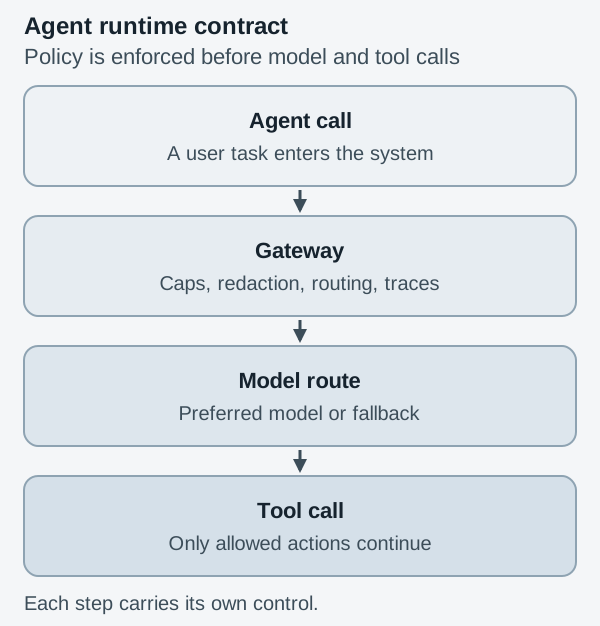
LangChain frames this problem clearly in its July 2026 article on the LangSmith LLM Gateway: production agents need centralized controls for model calls, including spend limits, rate limits, model fallbacks, sensitive-data handling, and trace metadata. The product is vendor-specific, but the architecture lesson is broader: agent teams need an enforcement layer between agent logic and external calls, not a collection of scattered checks inside each agent implementation. LangChain describes this gateway pattern as a central governance layer for runtime controls.
This is also why trace contracts are necessary but incomplete. In AI agent observability needs trace contracts, the trace is the record that makes agent behavior debuggable. Runtime guardrails are the deployment contract that makes the behavior bounded before the trace becomes an incident report.
What belongs in an agent guardrail contract?
A useful runtime contract is boring by design. It does not start with a grand theory of AI safety. It starts with the controls that prevent the most common production failures.
First, define spend caps. The contract should say who owns the budget, what time window applies, which users or tenants get separate limits, and what response the agent receives when a cap is reached. A cap without a designed fallback becomes a surprise outage. A cap with a product decision attached becomes a controlled degradation.
Second, define rate limits. Agent traffic is rarely as smooth as a dashboard average suggests. A new customer import, a bug in a loop, a batch task, or an enthusiastic internal user can create a spike. Rate limits should exist at the right levels: organization, workspace, API key, user, tenant, or workflow. The important point is not the exact taxonomy. The important point is that the limit lives outside the prompt and outside the most optimistic path in the application code.
Third, define fallback routing. If the preferred model is unavailable, slow, rate-limited, or too expensive for the current request, the system should know what to do. It may route to a smaller model, a different provider, a cached answer, a queue, or a human-review lane. Fallbacks are product behavior, not merely infrastructure behavior. A cheaper model may be acceptable for classification but unacceptable for legal-language drafting. A delayed answer may be acceptable for enrichment but unacceptable for checkout support.
Fourth, define sensitive-data handling. Redaction should happen before the model call, not only in stored logs. The contract should state which data types must be removed, masked, replaced, or blocked. It should also distinguish between data that can be sent to an approved model, data that can be used only in a private environment, and data that must trigger escalation.
Fifth, define trace review. When a limit blocks a request or a fallback fires, the trace should make the decision inspectable. The team needs to see which policy applied, which identity or tenant was involved, which model route was attempted, and whether the response was safe enough for the user context.
Where should fallback and spend limits live?
The wrong place for these controls is inside every agent. That approach feels fast when there is one agent and one provider. It becomes brittle when there are five agents, three teams, multiple tenants, and a model portfolio that changes monthly.
The better pattern is a runtime gateway. The agent still owns task logic, planning, tool choice, and user interaction. The gateway owns cross-cutting policy for model and tool calls. That separation gives product and engineering leads a cleaner contract: what the agent is trying to do sits in one layer, what the organization permits at runtime sits in another.
This does not mean every company needs the same vendor gateway. Some teams will use a commercial platform. Some will build a thin internal proxy. Some will combine API gateway rules, model-router logic, policy services, and trace pipelines. The implementation can vary. The architectural requirement is stable: there must be one enforceable path where spend, rate, fallback, redaction, and trace metadata are applied consistently.
This is especially important for tool access. If a model call can lead to a tool call that changes data, sends a message, opens a ticket, or triggers a payment-related workflow, runtime policy must cover more than token spend. The same mindset behind AI agents need tool permissions, not blanket access applies here. Permissions define what the agent may do. Runtime guardrails define when, how often, at what cost, with which data, and with what fallback behavior.
When does a guardrail become product behavior?
A guardrail becomes product behavior the moment a user experiences its consequence.
If a support agent says, “I need a human teammate to check this,” that is product behavior. If a research agent summarizes from a cached source because a premium model budget is exhausted, that is product behavior. If a coding assistant refuses to process a secret pasted into the prompt, that is product behavior. The user does not care whether the decision came from application code, a proxy, or a model gateway. The user experiences the system as one product.
That is why guardrails need product language, not only infrastructure language. Do not document only “limit exceeded.” Document the user-facing state. Is the task queued? Is the answer degraded? Is the user asked to narrow the request? Is the incident silent, visible, or escalated? Who can override it? Which customers get different limits because of plan, contract, or risk profile?
This is also where automation teams should connect runtime controls to failure classes. In AI automation needs failure classes, not retries, the key move is to stop treating every failure as a reason to try again. A rate limit, a policy block, a redaction event, and a provider outage are different failure classes. They deserve different recovery paths.
Audit one agent before the next deployment
Before the next production release, pick one agent that already runs or is close to launch. Do not start with a platform migration. Start with a one-page runtime deployment contract.
Write five sections. Spend caps: who pays, what limit applies, and what happens when the limit is reached. Rate limits: which identity level matters and how spikes are handled. Fallback routing: which tasks can move to another model, queue, cache, or human. Sensitive data: what must be redacted, blocked, or kept inside a private boundary. Trace review: what metadata must be recorded when a policy fires.
Then mark each section as enforced, partially enforced, or aspirational. The uncomfortable gaps are the point of the exercise. A production agent without runtime guardrails is not necessarily reckless, but it is unfinished. It may be observable, impressive, and useful, yet still lack the controls that make it safe to operate at scale.
The thesis is simple: production agents need runtime guardrails. Not as a slide in a governance deck. Not as comments in agent code. Not as heroic manual review after something goes wrong. They need spend caps, rate limits, fallback routing, sensitive-data redaction, and trace review turned into a runtime contract before the agent is trusted with real users, real data, and real money.