Article
RAG agents need evidence handoffs
When a simple RAG application fails, the team usually inspects the retriever, the chunks, or the prompt. When an agentic RAG workflow fails, the problem is more slippery. The answer may have passed through planning, multiple searches, saved notes, delegated analysis, synthesis, and a verification pass. If those steps only exist as internal tool calls, the final answer can look polished while its evidence trail is broken.
The thesis is simple: RAG agents need evidence handoffs, not hidden retrieval.
This is not another argument for bigger context windows or better vector search. Those matter, but they do not solve the operating problem. A builder or operator needs to know what each step passed to the next step, what claim it supported, and what was rechecked before the answer reached a user. LangChain’s RAG and deep-agent guidance describes workflows that plan, retrieve, save relevant chunks, analyze documents, synthesize with sources, and verify gaps rather than answering from memory when evidence is required: LangChain RAG documentation. That is the right direction. The next step is to make the evidence transfer explicit enough to audit.
Retrieval is not a private step
In many RAG systems, retrieval is treated like plumbing. The user asks a question, the system fetches documents, the model answers, and the product only shows the final text. This can be acceptable for a narrow FAQ bot where the answer space is small and the risk is low. It breaks down when the agent performs research.
Agentic RAG is not one retrieval event. It is a chain of decisions. The agent may decide what subquestions to ask, which corpus to search, which chunks to save, which passages to compare, and which gaps deserve another search. If those decisions are invisible, the final answer becomes hard to challenge. A reviewer cannot tell whether a wrong statement came from a bad source, a weak synthesis, stale memory, or a missing verification step.
This is why retrieval needs to leave an operational artifact. A related argument appears in RAG needs retrieval contracts, not bigger windows: the system must define what retrieval is expected to return, not merely increase how much text the model can see. Evidence handoffs extend that contract across the whole agent workflow. They ask a different question: once a chunk is retrieved, what exactly is handed forward, and for which claim?
What belongs in an evidence handoff?
An evidence handoff is a small packet of accountability between agent steps. It should be compact enough to log, but specific enough to support an audit. At minimum, it should include six fields.
First, the user question or subquestion. The packet must show what the retrieval step was trying to answer. A vague search such as “pricing” is not enough if the final claim concerns refund eligibility for enterprise customers.
Second, the query or tool input. This reveals how the agent translated the question into an action. Two agents can receive the same user request and search very different things.
Third, the retrieved source and chunk identifier. The identifier can be a URL, document path, database key, page range, timestamp, or any stable locator your system controls. The point is not to decorate the answer with links. The point is to make the source recoverable.
Fourth, the extracted evidence. Do not pass an entire document forward when the next step only needs two sentences or a table row. Save the relevant excerpt, with enough surrounding context to avoid quote mining.
Fifth, the proposed claim. This is the statement the next step is allowed to use. The handoff should distinguish evidence from interpretation. “The policy page says X” is not the same as “the customer qualifies for Y.”
Sixth, the confidence and open gap. The agent should say what remains uncertain. That gap may trigger another search, a human review, or a refusal to answer.
Where should verification happen?
Verification should not be a ceremonial last step. It should happen whenever a claim crosses a boundary.
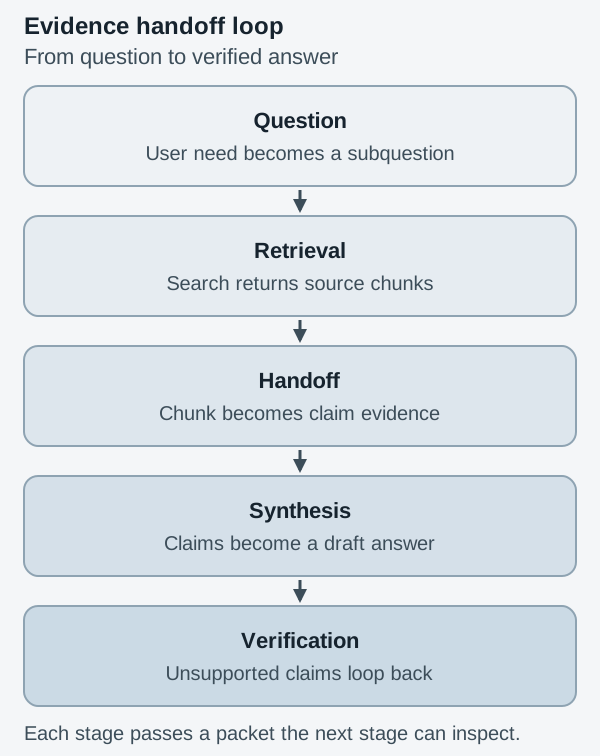
A useful pattern is retrieval, handoff, synthesis, verification, then answer. The retrieval step finds material. The handoff step packages evidence at claim level. The synthesis step combines claims. The verification step asks whether each claim in the draft answer can be traced back to a packet. If a claim has no packet, it is removed, rewritten as uncertainty, or sent back into retrieval.
This is where agent observability becomes practical. In AI agent observability needs trace contracts, the trace is not just a debug log. It is a contract about what must be visible when an agent acts. Evidence handoffs give that trace a content standard. Instead of reviewing a long stream of tool calls, the operator can inspect claim packets.
The verification pass should ask concrete questions. Which claims appear in the final answer? Which packet supports each claim? Did the packet come from a source allowed for this task? Was the evidence retrieved during this run, or imported from prior memory? Did the synthesis add a stronger conclusion than the evidence supports? Did the agent identify missing information, or did it hide uncertainty behind fluent prose?
How do you audit one RAG answer?
Start with one production answer, not a platform redesign. Copy the answer into a table. Break it into atomic claims. A sentence may contain several claims, so split aggressively. Then add four columns: evidence packet, source locator, verification result, and action.
For each claim, ask whether a reviewer can reopen the source and see why the system said what it said. If the source exists but the link between source and claim is implicit, mark it yellow. If the source does not exist, mark it red. If the evidence supports a weaker version of the claim, rewrite the answer. If the evidence contradicts the claim, treat it as a failure class, not a random hallucination.
This audit will usually expose a few patterns. The retriever found the right document, but the synthesis step overgeneralized. The agent saved a relevant chunk, but dropped the document date. A subagent produced a useful summary, but did not attach the original locator. The final verification checked tone and completeness, but not provenance. These are not model personality issues. They are handoff design issues.
The best fix is not to make every answer longer. It is to make every claim more accountable. Users may only see a clean paragraph and a few citations. Operators should see the packet chain behind it.
Make the handoff part of the product
Evidence handoffs are not only for audits after something goes wrong. They can improve the whole operating model.
A support team can use them to explain why an answer was refused. A compliance reviewer can sample high-risk claims without reading every trace. A product manager can see which documents repeatedly create uncertainty. An engineer can compare runs and see whether a change improved retrieval, synthesis, or verification. A subject-matter expert can correct the source interpretation instead of arguing with the model’s final wording.
This also creates a better boundary between automation and human judgment. The agent can retrieve, package, compare, and draft. The human can inspect the packets when risk demands it. The system does not pretend that fluent language equals evidence.
The call to action is deliberately small: audit one agent answer this week. Trace every claim back to a retrieved chunk. If you cannot do it, the problem is not only retrieval quality. The problem is that your RAG agent is passing conclusions forward without evidence handoffs.