Article
Agent memory needs dose tests
Persistent memory is tempting because it feels like compounding intelligence. An agent fails, you store the lesson. It gets confused, you preserve the correction. It handles an edge case, you add that pattern to the next run. Soon the system looks safer because it carries more of its own history.
That is the wrong default. Agent memory should be treated as a dose, not as a switch. Before expanding persistent memory, run a memory-dose test that compares the agent with no memory, curated retrieval, full memory, token overhead, saturation, and failure modes. The goal is not to prove that memory helps. The goal is to find the smallest memory strategy that improves reliability without drowning the model or hiding the next bottleneck.
The useful recent signal comes from the Hugging Face and IBM Research article How Much Memory Does Your Agent Actually Need?. Their evaluation compares baseline, full guideline injection, and curated retrieval across multiple models. The important lesson is operational: the right dose depends on model capability, task distribution, context capacity, and remaining failure modes.
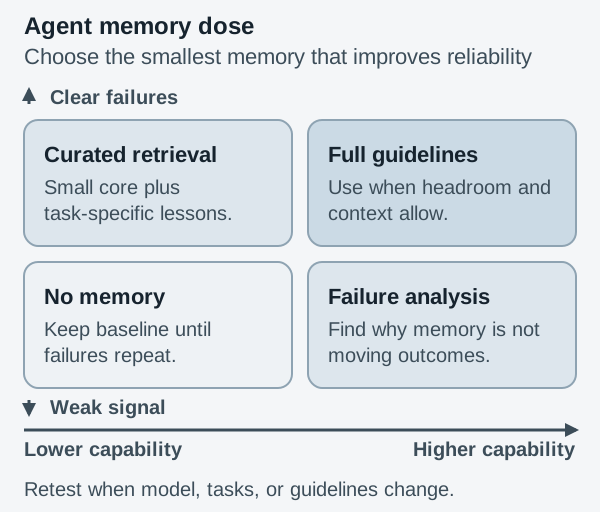
Memory is not a switch
Most teams introduce memory as a product feature. The agent will remember user preferences. The agent will reuse lessons from past traces. The agent will retrieve relevant notes. The language is confident, but the release question is usually vague: how much should the agent remember, and where should that memory enter the loop?
There are at least three very different things hidden behind the word memory. One is raw history, such as transcripts, tool calls, and observations. Another is distilled guidance, such as reusable rules extracted from prior runs. A third is task-specific retrieval, where only a small set of relevant lessons is injected for the current job. These are not interchangeable. Raw history can be noisy. Full guideline sets can inflate every step. Retrieval can miss the lesson that matters. The architecture may look more intelligent while becoming harder to predict.
That is why memory belongs next to context budgets and eval budgets, not next to feature toggles. If the agent already struggles to fit instructions, tools, retrieved evidence, and user context into a stable prompt, more memory is just another claimant on a scarce resource. The same discipline behind local agents need context budgets applies here: context is not a warehouse. It is an operating surface.
A memory-dose test starts by refusing the vague comparison between memory on and memory off. It asks for a ladder. What happens with no memory? What happens with a compact curated set? What happens when the full guideline set is injected? What is the token overhead per task? Which failures disappear, and which remain untouched? If the full-memory version wins by a tiny margin while doubling input tokens, the team has not found a strategy. It has found a trade-off that needs a release decision.
How much memory is enough?
Enough memory is the smallest amount that changes the agent’s failure profile in the tasks you actually ship. That definition is intentionally narrow. It prevents a common mistake: measuring memory by how much relevant text the system can retrieve rather than by whether the agent completes more work correctly.
Start with a fixed task set. Include routine paths, ambiguous requests, tool errors, missing data, permission boundaries, and scenarios where the agent must stop. If the agent is a multi-step operator, score complete task success, not just plausible intermediate reasoning. A memory system that improves step two but causes a bad tool call at step five has not improved the product.
Then run at least four configurations. First, the baseline: the agent as shipped, with no added memory. Second, curated retrieval: a stable core of high-confidence lessons plus a few task-relevant items. Third, full memory: all approved guidelines or lessons injected wherever the design says they should appear. Fourth, saturation review: a run that looks at cases where memory does not improve results, because no gain is also an important result.
Each configuration should report task completion, stricter scenario completion if available, average input tokens, average output tokens, number of tool calls, number of agent steps, and failure class movement. Did retrieval reduce missing-step errors? Did full memory reduce policy mistakes but increase instruction conflicts? Did token overhead rise because the agent took more steps, or because every step carried a heavier prompt? Those are different diagnoses.
This is where the connection to eval design matters. A memory-dose test without named failure classes becomes a leaderboard. It tells you which variant scored higher, but not why. The stronger pattern is closer to AI evals need fail-case budgets: define the failures that matter before the run, then track which memory dose moves which class.
When curated retrieval beats full memory
The Hugging Face and IBM Research article is useful because it does not flatten memory into a single best practice. In their reported results, some stronger models with headroom benefited from the full guideline set, while weaker models did better with a compact core and task-specific retrieval. They also reported a saturated pattern where added memory produced no measurable gain. That last case matters as much as the wins, because it warns teams not to confuse more context with more capability.
Curated retrieval can win for a simple reason: weaker models may not be able to use a large instruction pile well. A full set of guidelines may contain the right lesson, but the model still has to prioritize it against the user request, developer instructions, tool schemas, retrieved evidence, and its own intermediate state. If the model is already fragile, memory becomes noise. A smaller set can improve the signal-to-noise ratio.
Full memory can still be right. If the model has enough capability and context headroom, the rare edge-case guideline may be exactly what prevents a brittle failure. But that is a condition, not a slogan. Full memory should earn its place by improving the relevant failure classes at an acceptable cost.
Saturation is the easy pattern to miss. A strong model may show little gain from memory because it already solves the evaluated tasks, because the memory does not target the remaining failures, or because the evaluation is too narrow to expose the benefit. The response should not be automatic expansion. It should be failure analysis: collect the misses, inspect the traces, and decide whether the next intervention is better memory, better tools, better permissions, or a different task design.
Build the memory-dose test
A practical memory-dose test can fit into one release cycle. Pick one agent loop that already matters: a support triage agent, an internal research agent, a sales operations agent, or a coding assistant with tool access. Do not start with every agent. Memory problems are easiest to see when the task boundary is concrete.
Create a small ledger with one row per configuration. Columns should include memory source, injection method, retrieval rule, token overhead, cacheability, completion score, top improved failure class, top worsened failure class, and release decision. The release decision should be one of four options: keep baseline, ship curated retrieval, ship full guidelines, or investigate saturation. If the team cannot choose one of those, the test is not finished.
Also test trace readability. Memory can make an agent look more capable while making the reason for a decision harder to audit. If the agent retrieves five lessons and calls three tools, the trace should show which lesson was used, where it entered the prompt, and whether the final action depended on it. This connects memory testing to release governance. Agent releases need trajectory gates because a pass rate without an inspectable path is not enough for production autonomy.
The final rule is simple: expand persistent memory only after one loop passes the dose test. If curated retrieval gives most of the reliability gain at a small token increase, ship that. If full guidelines clearly improve hard scenarios and remain affordable, ship that. If neither moves the failures that matter, stop adding memory and study the bottleneck. The disciplined team does not ask how much memory an agent can hold. It asks how much memory the agent can use.