Article
Measurement systems need score receipts
Scores look clean. They turn messy histories, signals, and rules into a number that a workflow can use. That number can qualify a lead, block a transaction, prioritize an account, approve a discount, flag a customer for review, or reject a request. The danger is not the math itself. The danger is that the score becomes a hidden decision policy while the organization keeps treating it as neutral infrastructure.
Measurement systems need score receipts: every consequential score should travel with a plain operational record of its inputs, owner, threshold, use case, explanation, and escalation path.
The point is not to publish every line of logic to every user. The point is to make the decision explainable enough that a user can understand what happened, a support agent can answer without improvising, a product leader can own the tradeoff, and a regulator can see that the organization did not outsource accountability to a number.
In July 2026, the Italian data protection authority said that a customer denied an energy contract had the right to know the score behind that denial, in a case involving automated reliability scoring for electricity and gas contracts. The authority connected the score to access rights, transparency, and the practical consequences of being refused a service. That is the useful signal for product and analytics teams: when a score changes a real outcome, the score is not just an internal metric anymore. It is part of the decision system. The Garante Privacy decision and communication make that boundary hard to ignore.
The score is part of the decision
A score used only for exploration is different from a score used to change somebody’s options. A churn propensity score shown on an analyst’s dashboard may be a planning input. The same style of score used to exclude a customer from an offer, trigger a collections journey, deny a contract, or deprioritize support becomes operational policy.
That distinction matters because teams often govern the dashboard but not the moment of use. The model has a project owner, the CRM field has an admin, the workflow has an automation owner, and the support script has a different owner. Nobody owns the combined decision.
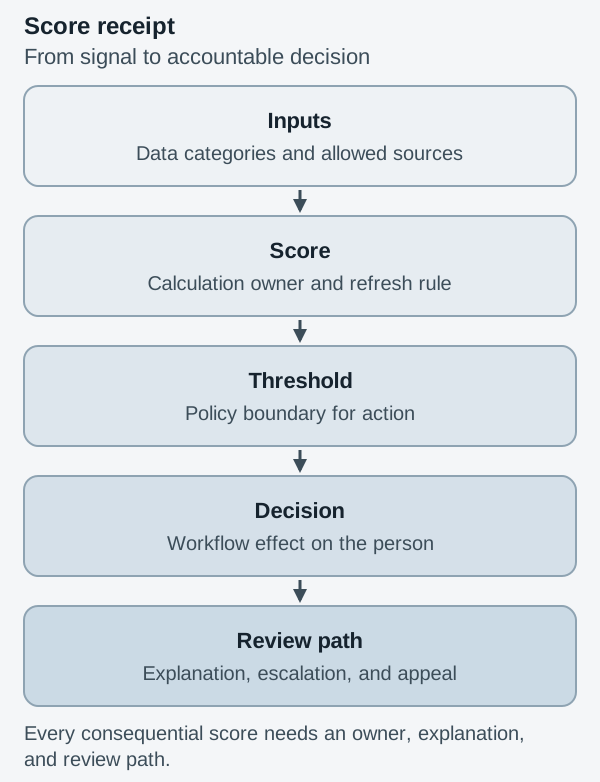
This is where score receipts help. A receipt says: this score was produced from these categories of inputs, calculated by this system, owned by this team, applied to this use case, compared with this threshold, and converted into this action. If the person affected asks why, this is the explanation we can give. If the explanation is insufficient, this is the review path.
This is the same discipline behind treating attribution as a contract rather than absolute truth. Measurement does not become safer because it is numeric. It becomes safer when the organization states what the number is allowed to mean. That is why the mindset in Attribution is a measurement contract applies directly to scoring systems: the artifact must name the decision boundary, not only the calculation.
What belongs in a score receipt?
A useful score receipt is short enough to maintain and concrete enough to operate. It should not be a legal memo that nobody opens. It should be a product artifact that can sit beside the workflow, the analytics spec, and the support playbook.
Start with the purpose. What decision is the score allowed to support? Avoid vague labels such as quality, value, trust, readiness, or risk unless the receipt defines the operational meaning. A risk score for payment default is not the same as a risk score for fraud, account abuse, service reliability, or sales conversion.
Then list the input categories. Not every feature needs to be exposed in public language, but the categories should be clear enough to detect inappropriate reuse. Account history, payment behavior, declared company size, device signals, usage events, third-party credit data, support history, and manual overrides are not interchangeable. If the score is built from data that users did not expect to influence the outcome, the receipt should make that visible inside the organization before the workflow reaches production.
Next, name the calculation owner and the use-case owner. They may not be the same person. The analytics team may own score production, while operations owns the threshold and product owns the user experience. A receipt without owners becomes decorative governance.
The threshold is the most important line. A score of 62 means nothing until the organization decides that 60 triggers manual review, 70 grants eligibility, or 40 blocks the path. Thresholds are policy choices disguised as configuration. If the threshold came from historical analysis, say so. If it came from capacity limits, risk appetite, compliance advice, or executive preference, say that too.
Finally, include explanation, escalation, retention, and monitoring. What will the user or employee be told? Who can review the decision? How long are the score and its inputs retained? How often does the team check for drift, unexplained denial rates, segment skew, and support complaints?
This sounds heavy only if the score is not consequential. If the score can materially affect access, price, priority, work assignment, or eligibility, the receipt is not bureaucracy. It is the minimum operating manual.
Who needs the receipt when something goes wrong?
The user needs a version of the receipt that explains the decision in human terms. Not a data dump. Not a vague sentence that says the request did not meet internal criteria. A useful explanation names the kind of information considered, the decision rule at a high level, and the next available step.
Support needs a richer version. Otherwise agents are forced to choose between saying nothing, inventing a reason, or escalating every case to a specialist. A score receipt gives support a safe answer pattern: what happened, what cannot be disclosed, what can be corrected, and where review lives.
Product and operations need the receipt to prevent accidental expansion. A lead score designed for sales prioritization may quietly become a discount eligibility rule. A health score designed for customer success may become a renewal risk label. A trust score designed for fraud review may leak into general customer treatment. Each reuse should require a new receipt or an explicit amendment to the existing one.
Analytics needs the receipt because measurement quality includes use quality. A model can be statistically valid for one purpose and operationally harmful in another. The lesson from Experiment readouts need decision rules is similar: evidence only improves decisions when the decision rule is written before the result becomes politically convenient.
Governance needs the receipt because proprietary logic is not the same as accountable logic. A vendor may not reveal every coefficient, but the company using the score still needs to know the categories of data, the contractual limits, the intended use, the explanation available to affected people, and the fallback when the score is challenged.
How should teams audit one score this week?
Pick one live score that affects a real workflow. Do not start with the most sophisticated model. Start with the score that already changes a customer, employee, or supplier outcome.
Write the receipt in one page. Purpose. Inputs. Owner. System of record. Refresh cadence. Threshold. Decision action. User-facing explanation. Support-facing explanation. Escalation path. Retention rule. Monitoring cadence. Known limitations.
Then test it with three questions. Could a support agent explain the decision without inventing facts? Could a product leader defend the threshold as a policy choice? Could an affected person understand what kind of information mattered and what they can do next?
If the answer is no, the score is not production-ready, even if the pipeline runs every hour and the dashboard looks polished. The organization has automated the decision faster than it has learned to explain it.
The operational standard is simple: no consequential score without a receipt. If a number can open, close, delay, price, prioritize, or deny an outcome, it deserves an artifact that makes the decision legible. That receipt will not remove every dispute. It will make the dispute governable.