Article
AI systems need security ledgers, not checklists
AI systems need development security ledgers, not launch checklists. That is the thesis, and it matters most when the product looks simple from the outside: a recommendation widget, a support copilot, a lead scoring assistant, a document classifier, a personalization rule that quietly learns from user behavior.
A checklist can be useful at the final gate. It asks whether encryption is enabled, whether access is approved, whether legal reviewed the release, whether the vendor was assessed. The problem is not the checklist itself. The problem is using it as the operating model for security.
AI development moves through data collection, dataset construction, annotation, model selection, training, evaluation, integration, deployment constraints, monitoring, and sometimes retraining. Personal data can enter or leak at several points. Dependencies can change. Training sets can be rebuilt. A model that looked harmless in an experiment can become sensitive once it is connected to user records or business actions. A launch checklist catches the state of the system at one moment. A ledger records how that state became true, who owns it, what evidence supports it, and what must happen when risk changes.
The CNIL guidance on AI system development is useful because it treats security as part of GDPR compliance during development, not merely as a production hardening exercise. It recommends risk analysis, DPIA documentation, controls for training-data confidentiality and integrity, dataset version logging, scrutiny of development environments and tools, audits, and measures that limit or stop unsafe systems when needed. Product teams should read that as an operating demand, not as a legal appendix: CNIL AI system development recommendations.
Security is part of the product contract
When an AI feature uses personal data, security is not a separate workstream that arrives after the product decision. It is part of the promise the product makes to users, customers, regulators, and internal operators. The feature is not only what the model outputs. It is also what data the model saw, who could modify that data, which model version produced the output, what dependencies were trusted, and how the team can prove those answers later.
This is why an AI workflow needs the same operational seriousness that agent governance needs. In Govern AI agents by autonomy level, not by vendor or model, the key move is to govern the decision rights of the system, not the brand name on the model. The same logic applies here. Security should follow the actual path of influence: data into model, model into workflow, workflow into user or business action.
A launch checklist often hides this path. It compresses a messy development history into a row of green ticks. The ledger does the opposite. It preserves the chain of custody. It names the owner of the data class. It records the dataset version used for training or evaluation. It states whether the dependency was reviewed. It links the audit evidence. It notes whether a DPIA was triggered. It states the deployment constraint. It describes the shutdown path.
That sounds bureaucratic until the first incident. Then the team needs to know whether the sensitive field was in the training set, whether the redaction job ran before or after annotation, whether the third-party package had access to raw data, whether the model output can be traced to a dataset version, and who can pause the feature without waiting for a committee.
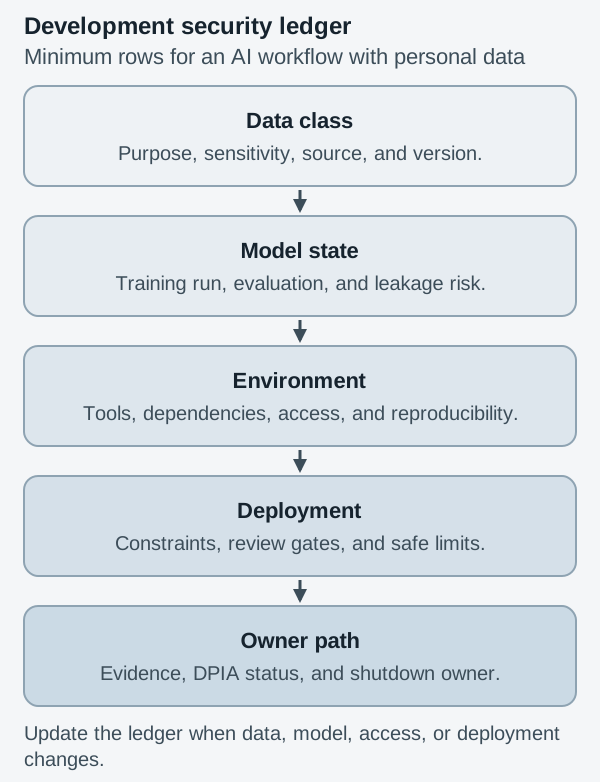
What belongs in the development security ledger?
The minimum ledger should be small enough to maintain and precise enough to answer risk questions. If it becomes a legal warehouse, nobody will update it. If it is only a release checklist, it will not help during development. Start with eight fields.
First, record the purpose and data class. The team should be able to say what the AI system is for and whether it touches personal data, sensitive data, vulnerable-person data, customer confidential data, or synthetic data. Purpose is not decorative. It limits what data belongs in the system.
Second, name the access owner. Not a group mailbox, not a department, but the accountable owner who can approve, remove, or review access to training datasets, annotation tools, feature stores, evaluation logs, and model artifacts.
Third, record the dataset version. The ledger should show which dataset version was used for which experiment, evaluation, fine-tuning run, or release candidate. If a dataset is rebuilt, the ledger should make the change visible.
Fourth, track dependency risk. AI systems often fail through ordinary software surfaces: APIs, notebooks, package dependencies, storage buckets, backups, authentication, logging, or admin tools. CNIL explicitly warns that risks can sit outside the model itself. The ledger should capture which components can touch personal data and whether they have been reviewed.
Fifth, keep audit evidence. Evidence can be a link to a risk review, an access export, a dataset validation report, an evaluation run, a threat model, a DPIA section, or a security test. The point is not to collect documents. The point is to make decisions reproducible.
Sixth, mark the DPIA trigger. If the workflow uses sensitive data, combines datasets, processes personal data at scale, affects vulnerable people, introduces an innovative technological use, or creates significant risks such as misuse, breach, or discrimination, the ledger should not wait for legal memory. It should show whether the DPIA is required, in progress, complete, or blocked.
Seventh, write the deployment constraint. Some AI systems should ship only for internal users, only with human review, only without retention of prompts, only for a limited geography, only below a confidence threshold, or only with certain fields masked. Constraints belong in the ledger because they are part of the product behavior.
Eighth, define the shutdown path. If the data source is compromised, if a dependency is revoked, if a model version leaks protected data, or if the output starts driving unsafe actions, who can stop the system and what happens next?
When does the DPIA change the roadmap?
A DPIA should not be a document that product discovers after the roadmap is already sold internally. If the AI system needs a Data Protection Impact Assessment, the roadmap now has a risk workstream. That may change sequencing, scope, release audience, architecture, or success metrics.
For example, a team may want to train on historical support tickets. The ledger forces a set of questions before the model work accelerates. Which tickets contain personal data? Which contain payment, health, legal, or minor-related information? Are annotations performed in a controlled environment? Can synthetic or masked data support integration tests? Is the model being evaluated for leakage? Does the deployment require a human approval step? What evidence will satisfy privacy, security, and product leadership that the risk has been reduced enough?
This is not anti-shipping. It is how autonomy expands without pretending that risk disappears. It also connects to observability. In AI agent observability needs trace contracts, traces are useful because they make runtime behavior inspectable. The development security ledger does the same before and around launch. It makes the system inspectable as it is assembled.
A good ledger can even speed decisions. Instead of convening a broad meeting every time someone asks whether the system can move from beta to general availability, the team can inspect the ledger. Are dataset versions frozen? Are access owners named? Is the DPIA complete? Are dependency risks accepted or mitigated? Is the shutdown path tested? If not, the roadmap is not blocked by vague governance. It is blocked by named missing evidence.
The ledger must have owners, not just fields
The common failure mode is to assign the whole ledger to legal, privacy, or security. That creates compliance theater. Product defines the purpose and deployment constraint. Data owns dataset lineage and quality controls. Engineering owns environments, dependencies, access implementation, reproducibility, and shutdown mechanics. Legal and privacy own interpretation, DPIA quality, lawful basis, rights, and risk thresholds. Security owns threat modeling, testing, access review, and incident readiness.
The ledger is where those responsibilities meet. It should be reviewed at development milestones: data intake, first training run, evaluation freeze, integration, limited launch, wider deployment, and retraining. That rhythm matters more than the template. If the ledger is updated only at launch, it has already become a checklist.
There is a useful parallel with Consent mode needs fallback states, not panic. Consent operations work when the team knows the fallback state before the signal breaks. AI security works when the team knows the safe operating state before the incident arrives.
Audit one workflow before expanding autonomy
Do not start by building a universal AI governance portal. Pick one AI workflow with personal-data exposure and write its minimum development security ledger. Choose a workflow that is real enough to matter and narrow enough to finish.
In one session, list the purpose, data class, access owner, dataset version, dependency risks, audit evidence, DPIA status, deployment constraint, and shutdown path. Then look for blanks. A blank access owner is a risk. A missing dataset version is a risk. An untested shutdown path is a risk. A DPIA trigger hidden in a meeting note is a risk. A deployment constraint that lives only in a Slack thread is a risk.
The goal is not to make every AI system heavy. The goal is to make risk visible at the point where product, data, engineering, legal, privacy, and security can still change the system. AI systems need development security ledgers, not launch checklists, because autonomy is not governed by asking one final question before release. It is governed by recording the evidence that lets the team know what it built, why it is safe enough to run, and how to stop it when the answer changes.