Article
Anonymized datasets need evidence tests
Teams preparing analytics exports for AI workflows often ask the wrong first question. They ask whether the dataset can be labelled anonymized. The better question is whether the dataset has passed an evidence test that a product, data, legal, and AI owner can inspect later.
That distinction matters because anonymization is not a magic state created at export time. It is a claim about what a reasonably motivated recipient can infer from the data, with the data available to them, in the context where the data will be used. The same table can look harmless inside one dashboard and become risky after it is joined with partner records, CRM segments, location fields, sparse event histories, or model outputs.
The current regulatory direction reinforces that operational view. The European Data Protection Board lists public consultations for Guidelines 02/2026 on Anonymisation and Guidelines 03/2026 on web scraping in the context of generative AI, both open for feedback from 8 July to 30 October 2026, which is a clear signal that anonymization and AI data supply chains belong in the same governance conversation (EDPB public consultations).
So the thesis is simple: anonymized datasets need evidence tests, not export labels.
The label is not the control
A label is useful for routing work. It tells a data warehouse job, an analyst, or a partner integration what category the export belongs to. But a label does not prove that the dataset is safe for a new use.
The weak version of the process sounds like this: the analytics team removes direct identifiers, renames a few columns, aggregates some events, and writes anonymized in the export ticket. That may reduce risk, but it does not create an auditable claim. Six months later nobody can answer which fields were present, which transformations were applied, who approved the export, which joins were considered, and whether the receiving system used the dataset only for the original purpose.
This is the same failure pattern as security governance by checklist. A completed checkbox can create confidence without leaving enough evidence for review. In AI systems need security ledgers, not checklists, the point was that responsible teams need a living record of decisions, owners, and exceptions. Dataset anonymization needs the same discipline.
The evidence test does not have to be bureaucratic. It can be a short ledger attached to the dataset release. What matters is that it makes the claim inspectable. If a team says the data is anonymized, the ledger should show what that statement means in practice.
What belongs in an anonymization evidence test?
Start with the source fields. The test record should list the categories of data present before transformation, not only the fields that remain after export. Product analytics can hide sensitive patterns in ordinary event names: feature usage, failed payments, device changes, location granularity, support interactions, error states, and account lifecycle events.
Then record the transformation method. Did the team suppress fields, generalize timestamps, bucket numeric values, aggregate events, add noise, sample users, truncate paths, or remove rare combinations? A vague phrase like cleaned dataset is not enough. The method must be concrete enough that another owner can reproduce the reasoning.
The next part is residual linkage risk. This is where many teams underinvest. The test should ask what a recipient could join against the dataset. Internal teams may have CRM identifiers, customer success notes, billing history, campaign audiences, or product telemetry. External partners may have their own customer lists, device graphs, public data, or purchase histories. AI workflows may create new derived fields that make old records easier to connect.
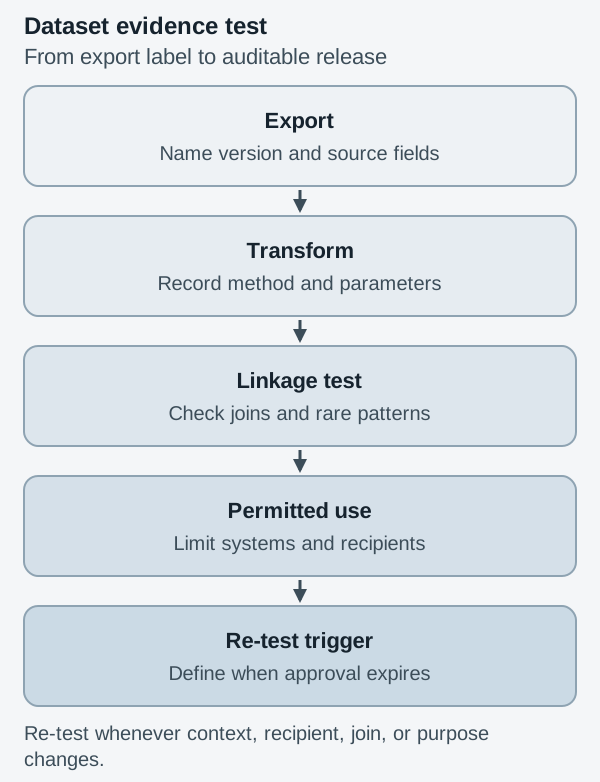
A practical evidence test should include at least seven fields:
- Dataset name and export version.
- Source field categories before transformation.
- Transformation methods and parameters.
- Residual linkage risks considered.
- Owner, reviewer, and approval date.
- Permitted uses, systems, recipients, and retention window.
- Re-test triggers.
This turns anonymization from a label into a measurement contract. The article Attribution is a measurement contract makes a similar point for marketing measurement: a number is only useful when the team knows what it is allowed to decide from it. An anonymized export is only useful when the team knows what it is allowed to feed, share, join, retain, or train.
Why does AI use change the residual risk?
AI workflows increase the surface area of a dataset. The dataset may be embedded, chunked, summarized, fine-tuned against, used for evaluation, searched by an agent, or copied into a feature store. Each step can change who can access the data and what can be inferred from it.
The risk is not only that a model memorizes a row. That is the obvious fear, but it is not the only operational problem. A retrieval system might expose rare event combinations through search. An evaluation dataset might include examples that reveal a niche customer behavior. A partner model might return segments that make re-identification easier when combined with internal knowledge. A data scientist might join a supposedly anonymous export with a newer table because both use the same time buckets and event sequences.
This is why permitted use must be part of the evidence test. An export that is acceptable for aggregate product trend analysis may not be acceptable for customer-level scoring. A dataset that is acceptable inside a controlled analytics notebook may not be acceptable inside a semi-autonomous agent with tool access. A table that is acceptable for a one-time benchmark may not be acceptable as a retained training corpus.
The goal is not to freeze every dataset forever. The goal is to prevent silent purpose expansion. Privacy operations already learned this lesson in consent management: when the signal changes, the product needs defined fallback states rather than panic. That is why Consent mode needs fallback states, not panic is relevant here. Dataset governance needs fallback states too: pause sharing, reduce granularity, remove fields, narrow recipients, or re-run the linkage test.
When should the dataset be re-tested?
A dataset should be re-tested when its context changes, not only when its file changes.
The obvious trigger is a schema change. If new fields are added, old fields are restored, or transformation parameters are weakened, the evidence test must be updated. But the less obvious triggers are often more important. Re-test when the recipient changes, when the dataset moves into an AI workflow, when retention is extended, when a new join becomes available, when a model output is stored next to the export, or when the business purpose changes from analysis to activation.
Teams should also re-test when population size changes. A dataset that is safe at broad country-level aggregation may become risky when filtered to a small enterprise account, a rare feature combination, or a thin cohort. Sparsity is often where re-identification risk hides.
The re-test trigger is the most important field in the ledger because it prevents the anonymized label from becoming permanent. It tells future teams: this approval was conditional. It was valid for this dataset, this recipient, this purpose, and this operating context.
Audit one export before AI use
The smallest useful action is to pick one dataset that is about to enter an AI workflow and write the evidence test before the export is approved.
Do not start with a company-wide policy document. Start with a real dataset: product events for churn prediction, support tickets for a summarization prototype, usage logs for a recommendation model, or aggregated analytics for a partner benchmark. Ask the owners to fill the ledger. If they cannot describe the source fields, transformations, residual linkage risks, permitted uses, and re-test triggers, the export is not ready.
This audit will usually reveal one of three gaps. Either the team does not know what is in the dataset, the team has not defined the permitted use, or the team has no owner for future context changes. Each gap is fixable. What is dangerous is approving the export because the filename contains anonymized.
Anonymization is not a stamp. It is an evidence-backed claim that must survive joins, recipients, model workflows, and time. If the claim matters enough to write on the export, it matters enough to test.